
Aluminum Can‑Stock Production Line
An integrated route from twin-belt casting to thin aluminum packaging strip. We configure the casting, hot-rolling, cold-rolling and annealing stages around your finished product and production requirements.
A complete route for can-body stock
Producing can-body stock requires more than reaching a thin gauge. The casting section must supply suitable material to the mills, while the rolling and heat-treatment schedule must deliver the dimensions and forming properties required by the can manufacturer. Our new can-stock configuration brings these stages into one coordinated line concept.
This configuration serves aluminum processors planning beverage-can body stock and related packaging strip. It is a separate, higher-capacity option from our standard industrial strip lines; the alloy, temper, surface condition and final product requirements guide the proposed equipment arrangement.
Configuration at a glance
Cast width: 1–2 m
As-cast thickness: 16–19 mm
Casting capacity: 20–40 t/h, depending on configuration
Final strip gauge: 0.245 mm after the complete downstream rolling and annealing route
The capacity above refers to the casting stage. Finished-coil output depends on the downstream rolling and annealing schedule. We match the equipment to the selected alloy, strip dimensions and production requirements.
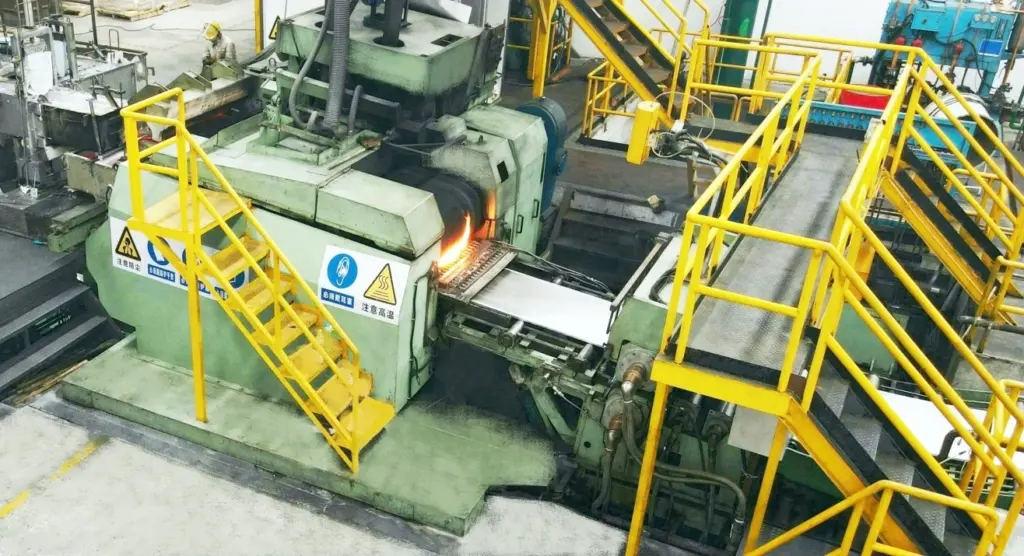
From continuous casting to finished strip
The twin-belt caster forms a continuous aluminum section for the rolling route. Hot rolling provides the initial thickness reduction. Successive cold-rolling passes then bring the strip toward its final gauge, with intermediate annealing used to manage work hardening and prepare the material for further reduction.
The 16–19 mm cast material and the 0.245 mm final strip are therefore outputs from different stages, not alternative products directly from the caster. We develop the reduction and thermal-treatment schedule for the intended alloy and can-making requirements, including the required temper, surface condition and forming performance.
Equipment and integration
The line concept combines twin-belt casting equipment, hot and cold rolling mills, annealing equipment, drives and automation. During project planning, we review material transfer between stages, mill duty, handling, maintenance access and the space available at the plant. This establishes how the complete route will operate and where it connects with the customer’s facilities.
For other industrial strip applications, explore our standard double-belt aluminum strip line. Its published configurations remain a separate range; the choice should follow the finished product and production duty.
Start with the packaging material you want to make
Tell us the intended application, installation country and production target. If you already know the alloy, strip width, final gauge or forming requirements, include them too. A complete plant specification is not necessary for an initial discussion.
Our engineering team can then work with you on the casting duty, rolling and annealing route, plant layout and equipment interfaces.